
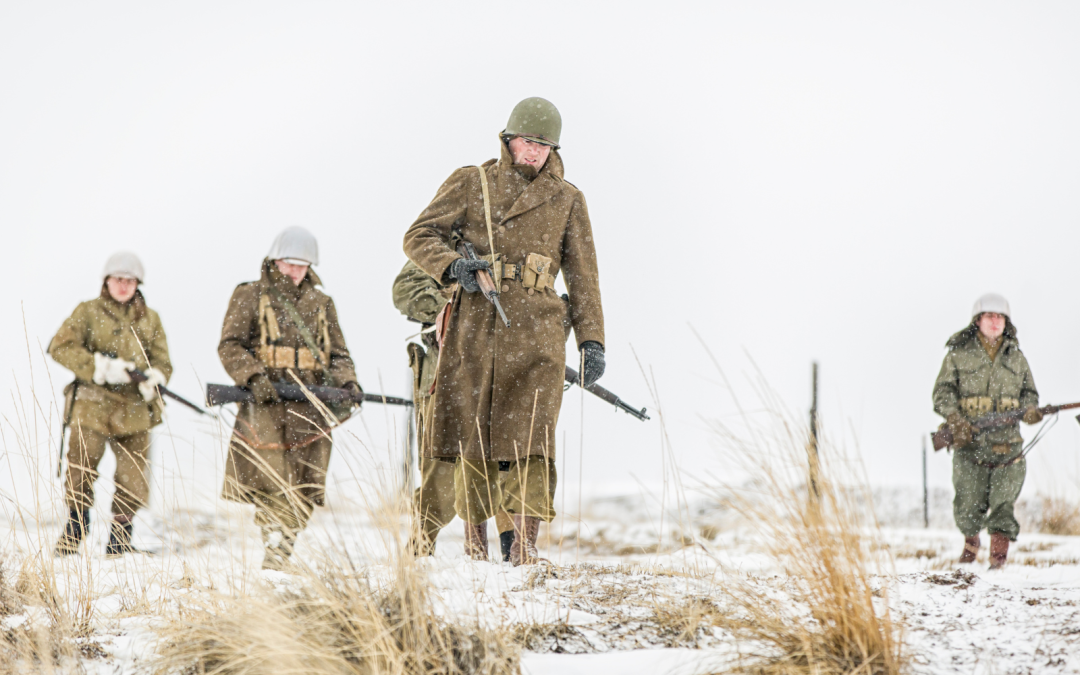
I've spent close to ten years putting on a wool uniform and walking into a field pretending it's 1944.
People ask what the point is. It's a fair question, and the honest answer took me most of those ten years to work out.
What it gets right
The weight. You can read that a rifleman carried sixty pounds. You don't understand it until you've hauled a pack, a rifle, a bandolier and an entrenching tool across a wet pasture in October and your shoulders are still sore on Tuesday. Every veteran I ever talked to mentioned the weight before he mentioned the enemy.
The cold. Wool is a miracle until it's soaked, and then it's a cold, heavy miracle that takes two days to dry. I've laid in a hole at three in the morning in November and understood, in a small way, why so many of the stories from the Bulge are about feet.
The boredom. Most of a soldier's war was waiting. Waiting for orders, waiting for chow, waiting for the truck that was supposed to be there an hour ago. A good event is ninety percent waiting too, and that's the most accurate part of it.
The small stuff. How a K-ration opens. How long it really takes to dig in. What coffee tastes like out of a canteen cup that had beans in it last night. None of that matters on its own. It matters because when a veteran tells you a story, you know exactly what he means, and he can see that you know.
What it can't get right
Fear. Nobody's shooting at us. I can make my hands cold. I can't make them shake.
Not knowing when it ends. We go home Sunday afternoon. They didn't have a Sunday. Some of them didn't have a Tuesday.
Loss. The fellow in the next hole is coming back next month with new boots and a story about his kids. That's the whole difference, and there's no way to close it, and I stopped trying a long time ago.
Age. Most of us are forty and fifty year old men with bad knees playing nineteen year olds. The real ones were kids. I try to keep that in front of me every time I put the helmet on.
So why do it
Because of what happened when the veterans came to the events.
An old man would walk the line, look at the gear, and ask if that was really how I carried the bandolier. Then he'd tell me how he carried his. Then he'd tell me about the day he lost it. The uniform didn't make me one of them. It just made me somebody worth telling.
Those conversations are where Tales from the Field came from. Not from books, and not from the reenacting itself. From standing in a field in the wrong wool, listening to a man who wore the right wool, because he could tell I'd at least tried to understand the weight of it.
Next time you see a bunch of us out there, come over. Ask about the gear. Then ask whether we've ever met anyone who wore it for real. That's where the good stories are.